Chapter 14 — Eudora Was Never the Keeper of the Secret
Several months after the hidden room was discovered, Roderick sat with Eudora in the same bedroom.
The wardrobe doors were open.
The false back was gone.
Behind the hanging clothes, the secure archive entrance was clearly visible.
Eudora looked at it.
“It looks different.”
“Good different?”
She nodded.
“Not scary.”
Roderick smiled.
That mattered.
On the day everything began, Eudora had not been frightened by ghosts.
Not by darkness.
Not even by the hidden passage itself.
She had been frightened because she knew something about her father and had been told she could not speak.
She had stumbled into the archive room and found Celestine beside a strange woman.
Photographs of Roderick covered the table.
Baby pictures showed a sister he had always believed was dead.
Then Eudora heard the woman say:
“I wish my brother knew I was here.”
Eudora understood only one part.
Her daddy had a sister.
Daddy didn’t know.
Mommy knew.
And Mommy said not to tell.
For three days, that secret grew larger inside her.
Every time Roderick came home, Eudora wanted to speak.
Every time, she remembered Celestine saying:
“Not yet.”
Then:
“It could change everything.”
Eudora began imagining what “everything” meant.
Daddy leaving.
Mommy crying.
The mansion changing.
Someone being angry with her.
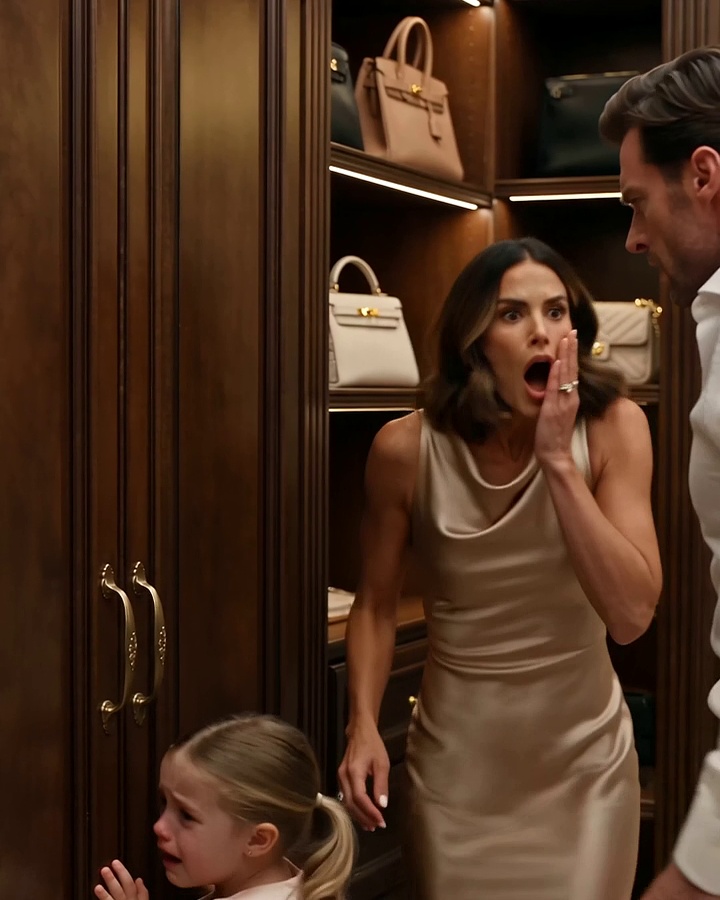
By the day Roderick found her beside the wardrobe, she could no longer carry it calmly.
She cried.
Then tried to tell him.
Celestine panicked.
She covered Eudora’s mouth.
“Quiet. Don’t say anything.”
That moment became the point where Celestine’s attempt at protection crossed a line she could no longer pretend was harmless.
Roderick found his daughter crying.
Saw her pointing.
Opened the wardrobe.
Moved the coats.
Pressed the false panel.
Then discovered the dark corridor.
The passage led to a room built into the oldest part of the mansion.
Inside was the history his father had hidden.
Mirelle had not died.
She had been adopted.
Her name became Mara.
She grew up loved by another family.
But separated from a brother who was told to grieve her as dead.
For decades, the evidence remained behind a wardrobe.
Photographs.
Adoption documents.
Letters from Isabeau.
Correspondence from the Harcourts.
The hospital bracelet.
The old photograph showing five-year-old Roderick refusing to put his baby sister down.
Then, decades later, a new envelope arrived.
FOR RODERICK AINSWORTH.
Mara had found him.
That should have been the moment Roderick received a choice.
Instead Celestine repeated the family pattern without realizing it.
She thought:
I need certainty before I hurt him.
So she opened the letter.
Verified Mara’s identity.
Contacted her.
Met her.
Brought her into the mansion.
And kept waiting for the right moment to tell Roderick.
Celestine’s intention had not been cruel.
But the problem was not only intention.
She made decisions about Roderick’s own history without him.
Then when Eudora accidentally discovered the truth, Celestine transferred part of the burden onto a child.
That was what she had to acknowledge before the family could repair.
She did.
Not immediately.
Not perfectly.
But clearly.
She told Roderick:
“I should have brought you the first letter.”
“I should have told you what I knew and what I did not know.”
“Then I should have let you decide what happened next.”
Most importantly, she told Eudora:
“I should never have asked you to hide it.”
The apology did not erase those three frightening days.
So the adults changed behavior.
That mattered more.
No more family secrets given to Eudora.
No more:
“Don’t tell Daddy.”
Or:
“Don’t tell Mommy.”
Not about serious things.
Not about family conflict.
Not about someone’s identity.
Not about an adult being secretly present.
If a secret made Eudora afraid, she had permission to speak.
Roderick made sure she understood the rule personally.
“What if Mommy tells me don’t tell you?” Eudora asked.
“You can still tell me.”
She looked toward Celestine.
Celestine nodded.
“Yes.”
“What if Daddy says don’t tell Mommy?”
Roderick answered:
“Same rule.”
“You can tell.”
Eudora smiled.
“What about birthday present?”
Roderick laughed.
“That kind of secret is different.”
“Good.”
“I like present secrets.”
The family laughed.
The mansion changed too.
The hidden passage remained.
But it was inspected, repaired, lit properly, and secured.
The false panel disappeared.
Anyone walking past the wardrobe could now see there was a protected doorway behind it.
The archive became known as the Family History Room.
Roderick preserved the original records.
He added Mara’s modern photograph.
Then photographs from their new meetings.
Not to pretend they had grown up together.
They hadn’t.
To show that the story did not stop where the old documents ended.
Mara eventually became a regular visitor.
Always through the front door.
Eudora started calling her Aunt Mara naturally.
Neither Roderick nor Mara forced the word.
It simply arrived.
One afternoon, Eudora found Mara looking at the photograph where Roderick held her as a baby.
“Daddy wouldn’t put you down.”
Mara smiled.
“Apparently not.”
“Do you remember?”
Mara shook her head.
“No.”
“Daddy does a little.”
“I know.”
Eudora thought.
“That’s sad.”
“A little.”
“But now you’re here.”
Mara looked toward her.
“Now I’m here.”
That did not recover the decades they lost.
Nothing could.
It simply gave them something after the loss.
Roderick and Celestine eventually repaired their marriage too.
Not because Roderick decided her secrecy had been harmless.
It hadn’t.
They repaired it because Celestine stopped defending the behavior once she understood the pattern.
She no longer said:
“I was only protecting you.”
Instead:
“I was afraid of hurting you, and I let that fear convince me I should control when you learned your own truth.”
That was honest.
Roderick could work with honesty.
What he could not accept again was secrecy presented as protection.
Years later, Eudora barely remembered every document in the room.
She did remember the wardrobe.
She remembered crying beside it.
Her mother whispering:
“Quiet. Don’t say anything.”
Then her father entering.
“What is going on?”
She remembered pointing.
Roderick moving the clothes.
The wooden panel opening.
The dark corridor appearing where a solid wall was supposed to be.
And then the moment he looked toward her.
She expected anger.
Instead he said:
“You are not in trouble.”
That became the part Eudora carried longest.
Not the fear of revealing the secret.
The relief after revealing it.
The truth did change everything.
But not in the way she feared.
Daddy did not disappear.
Mommy did not disappear.
The family became larger.
Harder.
More complicated.
But also more truthful.
A sister believed dead became Mara.
A dark passage became a history room.
A terrifying secret became something adults finally spoke about openly.
And Eudora learned one rule she would remember long after she forgot the details of the old mansion:
A child should never be made responsible for keeping an adult’s family truth hidden.
The secret behind the wardrobe had belonged to Roderick long before Eudora found it.
She was never its keeper.
She was simply the little girl brave enough to keep pointing until her father finally opened the door himself.
THE END
“`